Blockchain for Creators: Where Sovereignty Matters
Letting creators own their audience.
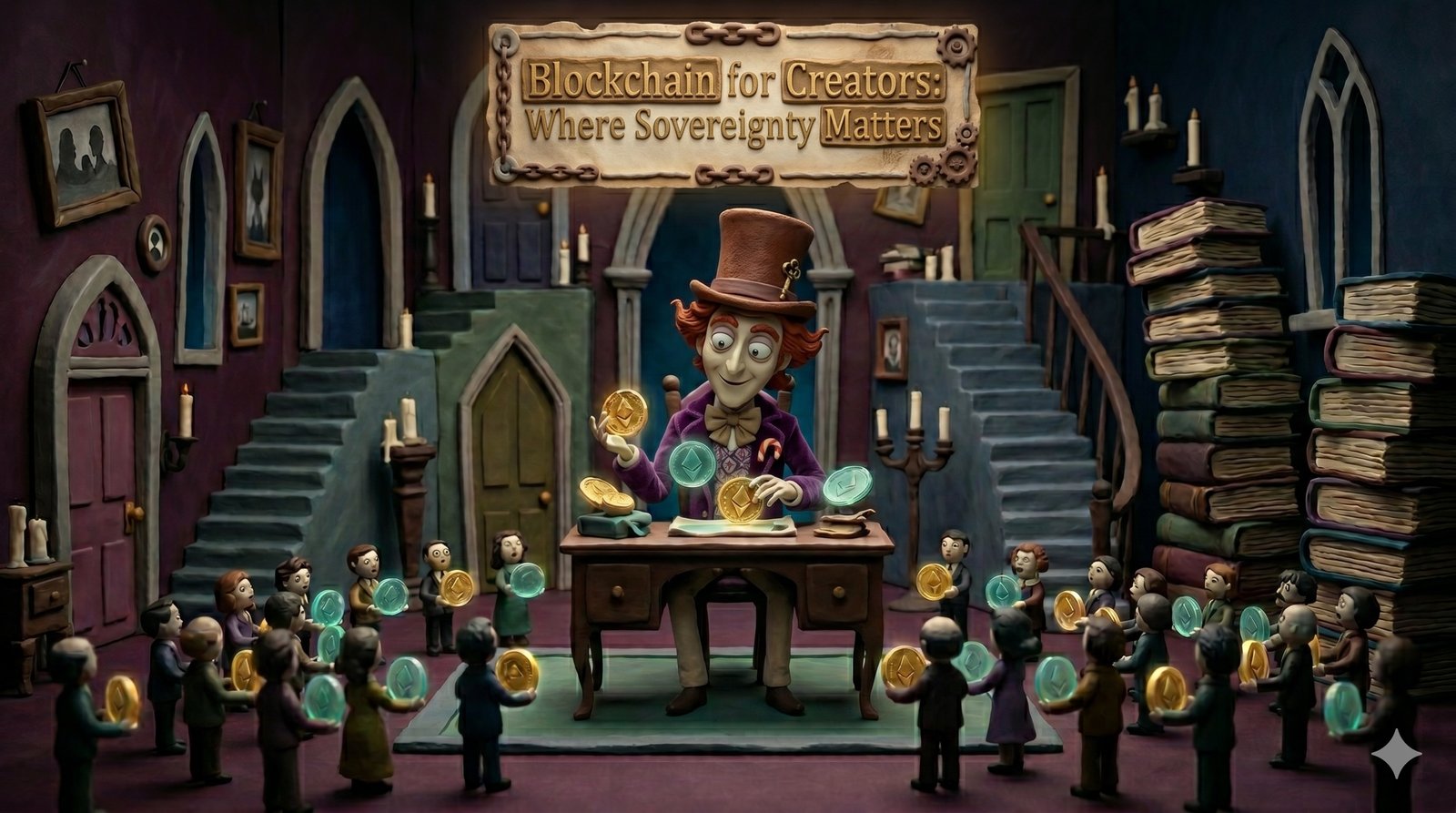
Most of what blockchain has produced in fifteen years is, by any honest accounting, financial speculation dressed in technical clothing. Tokens that exist to be traded. Protocols that exist to lend tokens. Exchanges that exist to clear the trades. Most of the criticism the technology gets is fair as applied to that layer.
But there's one application that justifies the rest of the apparatus, and in 2026 it's becoming visible in a way it wasn't before. The one thing blockchain does that nothing else does, and the one thing creators should care about, is that it lets you carry your audience with you.
A token-gated membership is the first portable customer relationship in the history of digital media. Everything creators currently rely on (Patreon, Substack, YouTube memberships, Discord boost tiers) is a customer relationship the platform owns and rents back to the creator. A blockchain membership is owned by the creator and the holder. No platform has the authority to take it away.
That's the application. The rest of this post is an argument for why it matters, what it costs, and how to actually run the play.
The real problem creators have
The creator economy in 2026 has a capital problem and a sovereignty problem, and most creators conflate the two.
The capital problem is the one everyone talks about. YouTube takes 45% on long-form ads and 55% on Shorts. Patreon now charges 10% to new creators on top of payment processing, before Apple's 30% iOS tax. Substack takes 10%. Twitch takes 50%. The numbers are ugly. They are not the deep problem.
The deep problem is sovereignty. A creator with 50,000 paying Patreon subscribers does not have 50,000 customers. They have 50,000 leases on customer access, terminable at Patreon's discretion, governed by Patreon's content rules, priced through Patreon's billing, and contactable only through Patreon's tooling. If the platform changes its policies, the creator absorbs the change. If the platform deplatforms the creator, the audience does not transfer. Every demonetized YouTuber, deboosted Substacker, and banned Patreon creator runs into the same wall: the relationship was never theirs.
Token gating fixes the sovereignty problem in a way no Web2 platform can. A membership pass that lives on a public blockchain is held by the fan, not the platform. The creator can verify the holder list anywhere, without permission. If they move from Discord to a self-hosted forum, the gate moves with them. If the platform disappears, the relationship survives. The credential is portable in the same way an email address is portable, but unlike an email address, it's also financial. It can be priced, resold, and stacked with other credentials.
This is the first time creators have had infrastructure that treats them as the principal rather than the platform's tenant.
Token Gates
Mechanically, a token gate is a smart contract that answers one question: does this wallet hold a specific NFT? If yes, the holder gets whatever sits behind it.
The list of things you can gate is essentially unlimited. Discord channels (Collab.Land, Guild.xyz). Livestreams (Unlock Protocol). Shopify products. Newsletter posts (Paragraph). Private podcast feeds. Event tickets. Voting rights. Early access to merch drops. Multi-tier perks where Bronze, Silver, and Gold passes compose with each other.
The right token standard for almost every creator membership is ERC-1155. It supports batch minting, mixes fungible and non-fungible IDs in one contract, and works identically across every EVM chain. ERC-721 (the original one-of-one NFT standard) is fine for signature artwork or fractionalized music masters, but for membership passes, edition drops, and tiered access, ERC-1155 is materially cheaper and easier to manage. Manifold's data shows minting 200 ERC-1155 tokens in a batched contract costs roughly 60% less than the same operation as 200 separate ERC-721 mints.
The token standard is solved. The interesting variable isn't the token. It's the chain it sits on.
Why Base
The chain choice in 2026 isn't technical. It's regulatory and distributional, and Base wins on both axes for U.S. creators.
The regulatory backdrop is straightforward. The Digital Asset Market Clarity Act, which passed the U.S. House 294-134 in July 2025 and is currently in Senate Banking markup, creates a "mature blockchain" framework that distinguishes networks free of common control from networks that are foundation-governed. Bitcoin and Ethereum clear the bar easily. OP-Stack rollups like Base will clear it once sequencer decentralization completes, and Coinbase has a public roadmap toward that. Foundation-controlled chains like Solana and Cardano don't currently clear it. Polygon's classification as sidechain vs. rollup is contested under the framework. For a creator who'd rather not spend the next five years arguing with the SEC about whether their membership pass is a security, the chain with the cleanest path to "mature blockchain" status is the right chain.
The distributional backdrop is even more decisive. Base is plugged directly into Coinbase's roughly 110 million U.S. users. USDC is native, fees run under a penny, and Coinbase Smart Wallet gives non-crypto fans a passkey-based login. No seed phrase. No MetaMask. No gas tokens to manage. A creator who deploys on Base can sell to a fan who's never bought crypto before, and that fan's first interaction with blockchain feels closer to creating an Instagram account than setting up a Ledger.
What creators should actually do
The path for a creator with an existing audience is short:
- Deploy a single membership pass.
- Cap supply at 100–500 depending on audience size.
- Price it at three to six months of what your audience already pays elsewhere, paid up-front.
- Gate one community space and one piece of exclusive content behind it.
- Pick a wallet flow that lets non-crypto fans sign in with email instead of a seed phrase.
- If the pass sells out, expand the perks before you expand the supply.
The mistake to avoid is treating the pass as a speculative asset. The pass is a membership, not a coin. The creator's job is to make holding the pass valuable through the perks attached to it, not through the price action of the token itself. Every project that has tried to make the token speculative has eventually failed when the speculation collapsed. Every project that has treated the token as access to a real community has had a much longer half-life.
Three honest catches worth naming. Secondary-sale royalties are no longer reliably enforced on most marketplaces, so creators should price the primary sale as if royalties will be zero. Wallet UX (even with embedded wallets) still loses some percentage of mainstream fans who don't want to learn anything new. The IRS treats every primary sale as ordinary income and every secondary sale as a capital-gains event, and a crypto-savvy CPA is worth talking to before launch. None of these are dealbreakers. They are real.
Two design choices worth thinking through
Lazy minting. Rather than paying to mint every token at launch, lazy minting registers the metadata for a batch and only writes a token to the blockchain when a buyer actually claims one. The buyer pays the gas. The creator pays only the contract deployment cost up front, and nothing per unsold token. If the drop sells twelve passes instead of five hundred, the creator hasn't pre-paid for 488 unsold mints. Most of the major minting platforms support this natively; turn it on by default.
Credit-card checkout for non-crypto fans. The cheapest answer is an embedded-wallet flow with email login. It's free, native to most chains, and most early-stage creators don't need anything more. Their existing audience is willing to learn one new step. If credit-card support is genuinely the bottleneck, there are services that sit on top of the contract and let fans pay with a card while a wallet is created behind the scenes. They cost a few percent per transaction and have meaningfully higher conversion rates than crypto-only checkout, but they're a scale-stage problem, not a launch-stage problem. Ship the cheapest version first; add card checkout when the data tells you to.
What this isn't
This isn't an argument that creators should abandon Patreon, YouTube, and Substack tomorrow. The Web2 platforms still have enormous discovery advantages, and a token-gated membership works best as a layer on top of an existing audience, not as a replacement for one. A creator with 100,000 YouTube subscribers and a Discord of 5,000 fans can launch a 500-supply pass and probably sell it out. A creator starting from zero cannot, and no amount of blockchain infrastructure will fix that.
This also isn't an argument that the rest of crypto is useless. DeFi, stablecoins, and tokenized real-world assets have their own theses, and some are even compelling. But for creators specifically, the application that justifies the technology is the one I've described. Everything else is either downstream of it or unrelated.
Conclusion
The standard pitch for blockchain in the creator economy is that it eliminates intermediaries. That pitch is half right. What blockchain actually does is replace one kind of intermediary (the platform that owns the customer relationship) with another kind: the protocol that records the relationship publicly. The creator doesn't become independent of all infrastructure. The creator becomes independent of any specific platform's permission.
A creator who builds on Base in 2026 isn't betting that Coinbase will exist in 2040. They're betting that Ethereum will exist in 2040, that smart contracts on it will still be honored, and that the membership pass minted today will still be verifiable then. Those are reasonable bets. The platforms creators currently depend on cannot offer the same guarantee, and many of them won't exist in their current form in five years.
The application is portable customer ownership. The chain is Base. The cost is under fifty dollars. The only real question is why more creators aren't doing this already.
Comments
Drop a thought below. Your email stays private. Only I see it. Your comment displays publicly under your chosen display name (or "Anonymous"). Comments appear after I've reviewed them.
No comments yet. Be the first.