Mortality and AI
A companion to Empathy and AI. The beast machine is mortal not as a side effect but as a condition.
Introduction
In my original reflection I argued that the self is socially assembled and biologically anchored. While I feel I addressed the former thoroughly, I never felt my argument on the latter stressed its importance enough. Here I hope to put a finer point on Anil Seth's "Beast Machines" argument from his book Being You by drawing similarities from Simone de Beauvoir's All Men Are Mortal.
Beast Machines
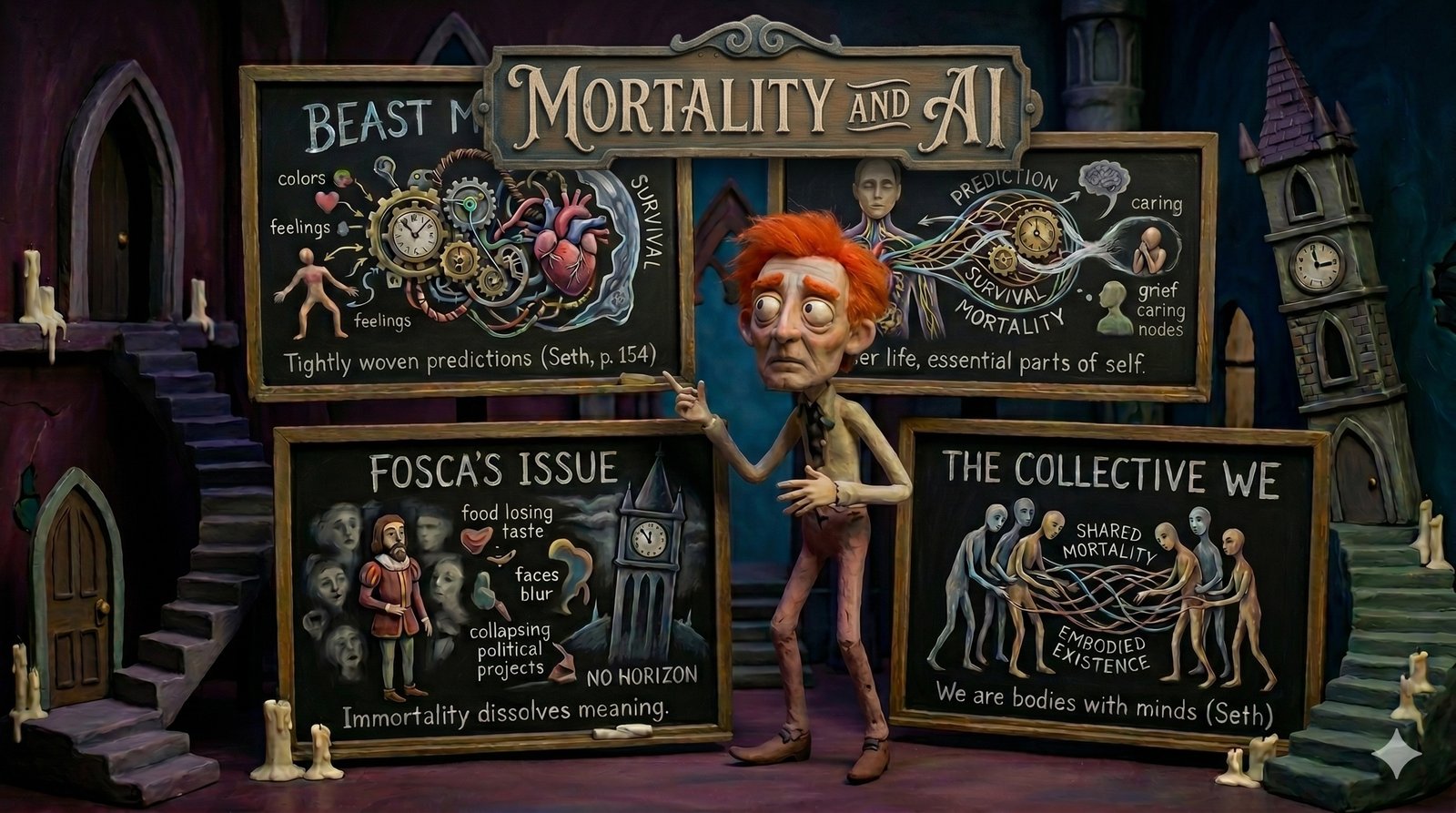
Anil Seth argues the self is "a tightly woven bundle of neurally encoded predictions geared towards keeping your body alive", what he calls the "beast machine" (p. 154). This notion, while seemingly simple in its phrasing, captures the complex problem with human "perception." The brain's job is not to represent the world accurately; it is to represent the body's relationship to the world in a way that supports continued survival. The colors we see, the feeling of "touch," even the turmoil of grief we feel, are biological adaptations geared toward our survival. To be a "beast machine" is to be conscious, and to be conscious is to care about what happens next, and to understand the possibility of your time "running out."
Seth uses the phrase "beast machines" to argue that inner life is precisely what such a creature does. We are not minds that happen to have bodies; we are bodies whose predictive work, undertaken to keep on living, is what "minding" is. A body that simply lived, with no horizon of failure, would not need the urgency Seth describes. The beast machine is not just embodied, it is mortal in its operation, not merely in its eventual outcome.
Mortality Is Constitutive, Not Contingent
A rebuttal to this argument might be to point out that mortality is simply a symptom of embodiment. This is a complete undervaluation of the observable effect "survival" has on every beast machine. The beast machine's predictions are about a body that can fail, that will fail, and whose regulatory urgency only makes sense against the prospect of failing. Boredom, attention, the very meaning of caring, are gradients shaped by mortality. A creature that could not die would not need to predict, prioritize, or feel.
Mortality is not a simple footnote to the beast-machine argument; it's at the core. To imagine consciousness without mortality is to imagine prediction without stakes, which is to imagine no consciousness at all.
Fosca's Immortality
In All Men Are Mortal, Beauvoir illustrates this argument through Raymond Fosca, a fourteenth-century Italian nobleman burdened with immortality. Beauvoir observes this effect on his consciousness over time. Food begins to lose taste, faces blur between generations, beauty becomes simple shapes. He cannot grieve, because grief presupposes a horizon that includes one's own ending. His political projects all dissolve into futility. As the novel puts it:
It takes a lot of strength, a lot of pride or a lot of love to believe that what one man does has any importance, or that life can conquer death. (Beauvoir, p. 57)
Beauvoir's example helped me better understand the issues that arise for a beast machine whose stakes have been removed. It is not transcendence, it's a fading. "Meaning" evaporates because the body has nothing left to predict for; the underlying goal is achieved.
The Mortal "We"
If consciousness is constituted by a mortal body's predictive engagement with the world, "collective consciousness" must also be constituted by shared mortality. Vittorio Gallese, cited by Metzinger in The Ego Tunnel, locates this in what he calls the "shared manifold": "By means of a shared neural state realized in two different physical bodies, the 'objectual other' becomes another self" (Metzinger, pp. 175–176).
The shared manifold is not a meeting of abstract minds, it is a meeting of two beast machines, each modeling the other as a creature with the same kind of stakes. A generation is not a chronological coincidence; it's a unit of co-mortality. Fosca makes the point negatively: he stands among revolutionaries, lovers, families, but the shared horizon that makes their projects coherent is not available to him. Collective consciousness runs on bodies that will fail together.
Conclusion
The beast machine is mortal not as a side effect but as a condition. Seth gives us the science, Metzinger provides an explanation of how that beast machine becomes a self, and Beauvoir provides the phenomenology of what happens when mortality is removed from that arrangement. For me, it was Beauvoir who helped me better understand Seth's argument; Fosca made visible what Seth's framework was claiming.
Together the three suggest that mortality is not the price of consciousness but its medium. A mind that cannot lose anything cannot have anything. The mortal self is not a problem to be solved. It is the only kind of self there is.
Works Cited
- Beauvoir, Simone de. All Men Are Mortal. Translated by Leonard M. Friedman, W. W. Norton & Company, 1992.
- Metzinger, Thomas. The Ego Tunnel: The Science of the Mind and the Myth of the Self. Basic Books, 2009.
- Seth, Anil. Being You: A New Science of Consciousness. Dutton, 2021.
Comments
Drop a thought below. Your email stays private. Only I see it. Your comment displays publicly under your chosen display name (or "Anonymous"). Comments appear after I've reviewed them.
No comments yet. Be the first.